This blog doubles as the production blog for the documentary film "The House That FREEDOM Built" and a renovation blog on the process of fixing this historic 18th century property.
I have known Gerard Emanuel for over twenty years when I first met him in 1990 when I worked with him on the US Census. I was 16 and worked as an enumerator. It was my first job ever! I had to beg my parents to do it as they thought that having a job and earning money would have made me think I was "grown". It was an amazing experience to have at that age, to walk into people's homes and ask them such personal questions about family, work and ethnicity. I remember that experience fondly and as I write this, I realize that I am doing that same job again, just in a different way, on a different scale, using a different medium.
Gerard Emanuel on Market and East St. Christiansted, reminiscing about his boyhood in town.
Gerard is a retired history teacher and a social sciences professor who has long ties to St. Croix, but especially Christiansted. Like many of the people I interviewed he talks about walking the town and in his case carrying messages for his mother. Reminding us once again of a time without cell phones, without landlines, a time where face-to-face interactions were the basis of communication. A time where like today, when you passed someone on the street you greeted them, "Good morning" or "Good Afternoon", and stopped briefly to exchange pleasantries and inquire about the well-being of mothers, grandmothers or children.
Gerard's family member's house on East St.
We also talked about the "untidiness" of slavery and its legacy, how race dynamics were not as neat and clear-cut as some might want to envision. Freed Blacks might have owned slaves. Whites masters might have fallen in love with their slaves. Freed Colored women might have used their sexuality to advance their position in society. And White Danes might have also exploited them. There were so many unanswered questions: What was the relationship between the Free Black community and the still enslaved community? Did the Free community see themselves as advocates for the enslaved or did they only seek out to create a way for themselves to have more rights and be more equal to Whites. Who is this figure of the "Housekeeper"? Was this simply a legal term to try to legitimize a romantic relationship with Black and Colored women? Were these women exploited or did they actively seek out these relationships with Danish men? How did the enslaved see the Freed Blacks? Did they aspire to be like them? Or did they see marroonage as a more desirable option considering the restrictions that Freed Blacks were also placed under? Many parts of this interview were less "interview" and more conversation, wonderings, as even my cameraman Tristan Jones jumped in with his own ideas.
Gerard also relayed some fascinating interpretations of how he felt culture operated as a form of social control. He commented on how jumbie stories worked as ways to keep children off of the streets, how discipline was often accompanied with proverbs that were not explained, but that you had to figure out the meaning to and how even the architecture of the buildings, like the jalousie windows, allowed one to observe the street and its "goingon" without the person on the street knowing they were being watched.
Jalousie window on home on East St, Christiansted
We also talked about the tension between celebrating and preserving a historic town, but still allowing for each generation to make its mark. He questioned the validity in wanting our town to only look the way it did in the 1800's especially considering that it represents a time where so many of the people were living under duress. He yearns for this generation to be also given the opportunity to use their imagination in fashioning our town. I hope that this work can open or inspire a path to making this happen, even if what this generation imagines is preservation.
At the turn of the twentieth century my house was owned by James C. Canegata, a shrewd businessman that over the next decade would own over twenty properties in town, have over 200 tenants, own a dry goods store and even a soda factory. I was able to interview his great-granddaughter, Dianne Canegata O'Reilly, an enterprising woman in her own right as she is the owner of Shay's Boutique on the corner of Company and Church St. The fact that her great-grandfather's store was on the same street as her own is only one of the many ways that this family has left an interconnected legacy in the town of Christiansted.
Dianne Canegata O'Reilly, great granddaughter of one of the previous owners of my house, James C. Canegata
In the Virgin Islands perhaps the most famous of the clan is the beloved Dr. David C. Canegata whom the Christiansted ball park is named after. Dr. Canegata was the first Crucian to become a physician, was a member of all three branches of government and was an active humanitarian. Although coming from a rather privileged background of going to exclusive boarding schools in Antigua and being educated in Montreal, when he became a physician he is often described as taking a chicken for payment of medical services or not accepting payment at all.
Dr. David C. Canegata, son of one of the previous owners of my house
However, there is perhaps an even more famous Canegata that many Virgin Islanders know nothing about. Lionel C. Canegata, better known as Canada Lee, was the son of the first born son of James C. Canegata. It appears from baptismal documents and Census records that James C. Canegata had a son before David with a woman by the name of Fanny Levy. At 17 James C. Jr. left for NYC and became a part of the Harlem Renassaince movement with other notable Virgin Islanders like Hubert Harrison and Casper Holstein. His son, Lionel, born and raised in NYC became a famous jockey, boxer and then later an actor in both theater and film. Nicknamed Lee from childhood, it was during a fight as a boxer where the announcer mispronounced his name and Canegata became "Canada" and stuck.
Lionel C. Canegata aka Canada Lee, famous boxer and actor
And what is even more amazing about this process of researching the Canegatas is that we believe to have uncovered a younger brother to Dr. David C. Canegata, James Albert Canegata, apparently born in 1895 according to the St. John's church records! It was exciting and incredible that as we searched for better clarification on Canada Lee and who his mother was, we discovered indeed another brother. This was an unexpected surprise to the surviving Canegatas on St. Croix.
However, separate from the family discoveries, Dianne relayed a fascinating image of a strong and united family. One with beautiful traditions and a strong sense of place. She recounted memories of family gatherings at "The Hill" as her grandparents house was affectionately referred to, where all the Canegatas gathered for dinner on Sunday, Easter or Christmas. Unfortunately the beautiful historic home she describes was destroyed in 1989 in Hurricane Hugo. What remains on this large property are the steps she remembers using to enter her grandparents home.
Steps to Dr. David C. Canegata's home on Fisher St. Christiansted, the remains of Hurricane Hugo in 1989
View of Canegata property on the corner of Church St. and Fisher St.
One of the other reflections she shared that stood out to me was a comment about what it felt like to recognize a particular brick on a street that you have canvassed your entire life. Having walked these streets as a child and now as an adult, she said it gives her a tremendous comfort and sense of self to be able to do that. It was a small but profound description of a true sense of place and belonging. It is that same sense of place and ownership that I hope my documentary can inspire.
Sonia Jacobs Dow, Executive Director of the St. Croix Landmarks Society
This week I had the opportunity to interview Sonia Dow, executive director of the St. Croix Landmarks Society. It's an amazing organization dedicated to the preservation of cultural heritage. They run two museums, a library and have great programs, exhibits, concerts and tours. Ms. Dow also has connections to Free Gut and the larger Christiansted, so she was a natural choice for an interview subject that deals with the town, the buildings and the story of its former residents.
Sonia Dow, Executive Direction of St. Croix Landmarks Society in front of "My Granny House"
We interviewed her on the property of the Estate Whim Museum. I have actually had an exhibit there. You can see a link here and here to view some of the images from that show.
Iron Bed as a part of the "My Granny House" Exhibit at the Estate Whim Museum
However we chose to interview her in front of a beautiful wooden house that was constructed about 20 years ago that has been recently converted into an exhibit entitled "My Granny House". The first time I entered the house it brought back so many memories of both of my grandmothers houses. My grandmother in Barbados and Tobago have similar homes. The kitchen, the bed, the grip, the dollies, the crochet doll, the rocking chair, coal pot all made me think of my Granny and how my parents grew up. Both of them in one and two room wooden houses that they shared with 6-8 people.
What was most memorable to me about our interview was Ms. Dow's commentary on the effect of uncovering one's family history. She talked about the varied emotions that surface when someone finds that first African born ancestor or the first ancestor that was a slaveholder. Due to the meticulous Danish accounting of property taxes, and we remember that slaves were considered property, it is possible for many Virgin Islanders to trace their family history in their library. The process, she says, is incredibly healing, the stories are healing. And for me, although I am not related to anyone that owned my house, we agreed that the stories are powerful enough that they transcend bloodlines. It was a great reminder of one of the many reasons that I am doing this documentary.
Frederiksted Huckster, 1900 Danish Maritime Museum
Several of the people who owned my house were women. During the Danish
colonial time women were able to obtain freedom by a variety of
ways. One of them was by being a huckster, an itinerant vendor who sold
bread, fruit, herbs or vegetables and with the money they earned some were
able to purchase their freedom.
Oceana James as a Huckster for the film "The House That Freedom Built", July 2013
The huckster is another version of the quintessential image of
a Caribbean market lady. From the perspective of a visual artist I have often felt that these
images have often been over-used and romanticized in painting. While doing this
project I have gained a new understanding for the fortitude of these
women and a new appreciation for who they were and what they represent.
Simple things, like trying to find a tray/ basket that was the right size for
our reenactment made me understand that these women would want a tray
large enough to carry enough goods to make money, but not too large that
you couldn't bear the weight. And then of course one imagines these
women walking around often balancing this weight on their heads.
Oceana James as a "Housekeeper". Effects test for the film "The House That Freedom Built", July 2013
And then there is the more controversial image of the "housekeeper".
Often Danish men would have come to the colonies without their families.
Although it was illegal for them to marry women of color and even live
with them in a romantic capacity, the position of a "housekeeper" was legal. This would be a woman who worked for a Danish officer in
his home, the use of quotations signifies that this relationship was
often more than laundry and cooking. It was often also sexual and might have also produced children. These liasons were also one of the ways that women could obtain their
freedom.
Oceana James as a Huckster for the film "The House That Freedom Built", July 2013
Sayeeda Carter as a Huckster for the film "The House That Freedom Built", July 2013
Two beautiful actors worked on these representations with me, Oceana James and Sayeeda Carter. It was a fun day. We worked in the late afternoon so the lighting was beautiful. Several people stopped us while filming to ask about the project and they were very intrigued. Since our entire town is historic is was amazing how quickly you were transported back in time.
Although there are some photographs like the one below of "Big Mouth Catherine" that I may be able to use for the film. I wanted some more diversity in my imagery. My cameraman, Bill Stelzer, talked about why historical images tend to look the way they do, why the portraits all seemed to have a despondency or emptiness in the expression.
Huckster, "Big Mouth Catherine", 1890 Danish Royal Library
He reminded us that taking a picture in the 1800's meant that a subject would have had to stand still for several minutes often resulting in a certain "stiffness". Videotaping our actors gave another dimension of life: smiles, gestures, etc. I look forward to seeing how it all fits together in the film.
Sayeeda Carter and Oceana James as Hucksters for the film "The House That Freedom Built", July 2013
6B Fisher Street, home of Suzette Bough James in Christiansted, St. Croix
Her house actually feels like it's more on King Cross Street, but she said that because they seemed to mark the houses based on where the front door opens to, hers is marked as 6B Fisher St. I thought that was interesting. Suzette or Suzie as she is most preferably called comes from a large and well established Christiansted town family, the Boughs. She is a retired art teacher who was born and raised in Free Gut, or Hillside as the neighborhood is most commonly called by the generation who experienced its heyday in the 1940's-60's. Every time I interview someone from this generation I yearn to have lived in that time. It sounds like a magical era, where everyone knew each other, and loved each other and looked out for one another. A time where although people lived with far less materially, they seemed to have a lot more joy, more sense of community and more dedication to family. She describes the town as beautiful, well cared for and full of life.
Suzette Bough James, resident of Free Gut, Christiansted
When I asked her about the earliest memory of her house she told me a moving story about the day her mother died. She said she was five years old and she remembers walking into the house for the first time without her mother in it. She commented on the way the jalousie windows (wooden louvered windows) were open and that later neighbors had come by to comfort her.
Although the windows have changed, they are now glass louvered windows and covered with iron grill work to keep out the burglars (she's had a few over the last decade), the view has not changed. We stood there imagining this class of Freed Blacks looking at the same view of the ocean and wondering what they thought, what they felt. We both agreed that their view must have reflected back to them a sense of freedom and tranquility.
View from "Hillside" at the home of Suzette Bough James
The other day I was at the house and heard voices. I was surprised because most of the houses in the area are abandoned. When I went to see where the voices were coming from I was pleasantly surprised to see that the house just behind me had some people that were about to open it. Toney Prescot has just come back to St. Croix to start the renovation of his family property.
My neighbor Toney on Prince St. He has just come home to renovate his family property.
I was thrilled to meet he and his wife Rose and talk to them about my renovation project and the documentary. I was able to interview him today and collect his memories of growing up in the area. He is apparently family to the owners who preceded me and shared a lovely memory of "Auntie Dolly" as he called her. He talked about how most of the family had moved to the states, but that every time she came home the first thing Auntie Dolly would do when she arrived was go outside to look for and collect her "bush". It was a striking image of an elder returning home and looking for her "roots", literally.
Toney's family property on Prince St., Christianted.
Normally the area is quiet because of the abandoned properties, but today it was a challenge for us to find a place to do Toney's interview. This was a good thing because all of the noise was construction noise. My neighbors on both sides and myself were busy renovating and working on our properties. It was good to see that. It was a wonderful affirmation on how the universe works. There is a synergy happening. One by one, house by house, Christiansted is coming alive again.
The wooden part is the oldest part of the house. The concrete additions of a kitchen and bathroom were done later in the early 1900's. It is the wooden section that needs the most repair. Next week I meet with my carpenter who will be assisting me to figure out how much we can save and what absolutely must be replaced. This dilemma between renovation vs restoration has been a struggle and you have to ask a lot of questions, because in my experience, most carpenters will tell you to take the whole thing down and start again. They will tell you it will look better, last longer, that they don't like mixing new with old, that it will be more work, more expensive, and they will look at you like you are crazy when you ask them the same thing four times sometimes in the same way, sometimes in different ways, to see if you will get a different answer. The funny thing is that older materials were of higher quality, so you definitely want to try to save as much of it as possible. So it's funny when a carpenter tells you to throw 100% out when it's really 10, 25 or maybe even 50% that is damaged. And also funny enough (hah, hah, do you hear me laughing?) the older materials are also made at different measurements. So the older 4x4 beams are not really 4x4 beams but 3 and 1/2 also making it difficult to match old with new.
18B East St, Christiansted. The oldest part of the building, built in the late 1700's.
At this point however, it looks like most of the supporting vertical beams have been compromised. You can see this in the picture from all of the horizontal beams that have been placed in between to try to brace the building. Despite this effort, it's sinking in some areas, leaning in others and so we will have to take up the floors, jacked up the part that is sinking and check the other supporting floor boards. In this process I will be able to ascertain how much of the original floor I can keep, if any, it's in pretty bad shape. The ship lapped wood (horizontal in blue) is also rotting. However, I will go board by board and try to save as much of this as possible too.
This will be the most costly part of the renovation. Wood although 100 years ago was cheap, today it's quite expensive and in the St. Croix, many people have moved away from building wooden homes because of the upkeep, pests and fear of hurricanes. But more than that, I think that wood houses have also because become synonymous with poverty. They remind us of an era many would prefer to forget. Yet what I find interesting is that many of these houses were also usually built by the hands of its inhabitants. They are handcrafted, which in our modern world of manufacturing and prefab is becoming less and less common.
I also find it interesting the words we use to describe wooden houses and how they denote different ideas. Shack, cottage, cabin, chattel house, board house, row house, beach house are all typically made of wood, but they all mean very different things. I'm not sure which one of these words best describes this house. It's obviously not a beach house or a cabin. I'm working on it to no longer be refereed to as a shack :). It's not a board house which typically means it was made with plywood. And although slaves lived there at different times in it's history, it's not really a chattel house either as it was owned by freed slaves in an area designated for freed slaves to live. So...I suppose it's somewhere between a cottage and a row house. Looking forward to seeing how it feels and fits on this continuum when it's done.
My amazing and always helping mother, Claudia Belle, helping out in clearing up the yard. We are trying to make it a little safer for the kids to be around.
Today I spent time in a prison. An open one, a forgotten one. One of the few prisons specifically built to house enslaved Africans, the prison in Richmond is our Robben Island. Built in 1834 it was constructed to control and punish the most rebellious of the enslaved, like our most infamous/famous freedom fighter General Buddhoe.
Moses Gotlieb aka "General Buddhoe" lead the 1848 slave rebellion in St. Croix, Danish West Indies. He is on record as being imprisoned three times in the Richmond prison prior to this revolt.
Although I received different dates, it seemed to have functioned as a prison until the late 60's. And then...slowly, like so much of our history we forgot it. Today, most people do not know that there was even a prison there. And of those that do, many do not know that it was a part of the colonial system.
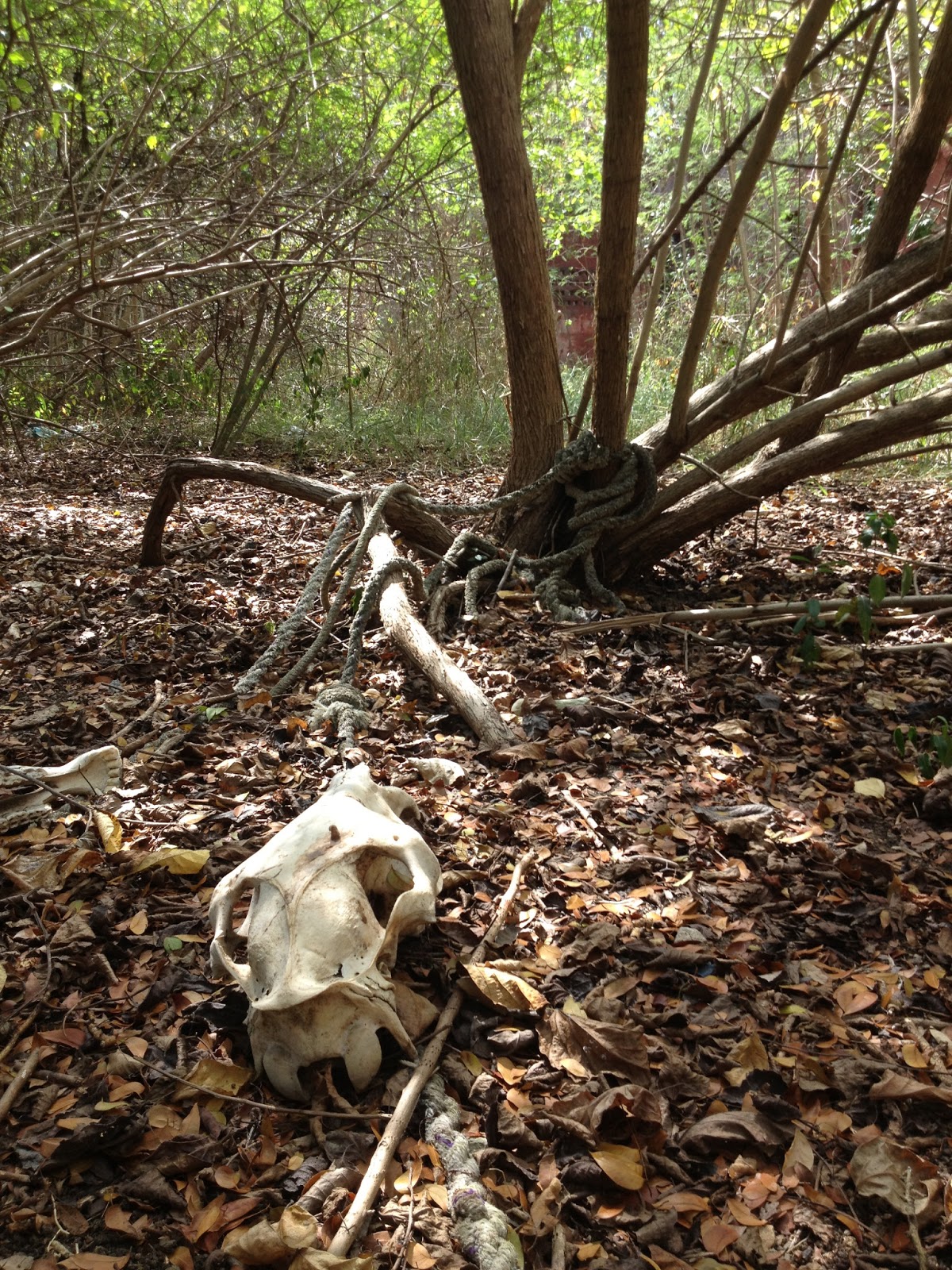
While I was there we happened upon some bones in the courtyard. It
was the same courtyard that two hundred years ago enslaved people would
have been forced to work as their punishment, doing back-breaking tasks
like breaking rocks. I found in the courtyard bones of an abandoned horse that was left
tied to a tree. Someone just left the poor animal there. Perhaps they forgot it. I find
it to be an interesting metaphor.
One of the cool things about doing this project and having a website/blog is that people reach out to you. It has become a way that like minds and people interested in this field have found me. Last week I met with a Danish professor, Helle Stenum, who was visiting St. Croix and teaches cultural and migration studies at Roskilde University.
Helle Stenum, Danish professor of Culture and Identity
She was interested in talking about my project and the links between Denmark and the Virgin Islands. I took her to see the house. I was commenting on the renovation and the craftsmanship in the buildings, specifically the beading that is found in the rafters and the siding. Many of this work was done by hand. Today machines can do this work, but it can be still expensive to reproduce. I chose not to replicate a lot of these details because of the time and expense, but am happy that the older part of the house still has some.
Vernacular details of Christiansted house. Hand-planed beading in exterior wall.
She looked around and said, "They loved their houses". I paused. "Yes, they did," I responded. It was such profound moment for me. A simple realization. They. Loved. Their. Houses. The details, the craftsmanship, the time, the care: they loved them. To put those kinds of details in a simple 100-200 square foot house, shows a level of pride that is awe inspiring. Let us remember that.
Vernacular details of 18B East Street. Hand-planed beading in rafter.
It's a New Year! 2012 was a challenging year. I am happy to welcome in 2013. This is the second long hiatus from this project, this time brought on by the birth of my third daughter: Maisara. I can't say that I'm back in full swing, but I'm swinging. So here's the update:
In October of 2012 I was able to put some money aside to fix the roof. Without the roof, I couldn't go forward on anything else and I knew it would be the most expensive part of the renovation. I was very anxious about finding the right person to do the job who was also within my budget. I spent about $1500 in labor and another $2500 in materials to redo the roof. I had originally anticipated taking off the gavaloom, maybe even reusing some, and putting the ceiling back on. It seems that the roof came off previously in a storm and they only put back the galvaloom without the interior ceiling.
18B: July 2011 after cleaning out most of the trash.
18B East Street: October 2011. Roof coming off.
As it turns out when the workers started taking off the metal sheets, large chunks of the rafters were coming out with it (ie, I now had to replace the entire roof!) So I scrapped the original idea about reusing any metal sheets and just did the whole entire roof. Actually we did preserve the interior of the wooden section of the house.
Well the old adage in construction is very true: you get what you pay for! There are issues that need to be fixed and other issues that cannot be fixed. One thing though, the roof does not leak, but because of the pitch, even with holes it wasn't leaking before anyway, and probably never will. Will it stay on if we get another Hurricane Hugo? Not sure.
18B East Street: Ceiling on, beams changed.
18BEast Street: Ceiling and Roof on. Walls first coat of paint.
According to one contractor (contractors always criticize other contractor's jobs) some areas are not tied down properly and the metal sheets were cut too short along the width of the building. When I spoke to the guys who did the job for me about these issues, their response was: "We put it back just how it was, that was the job". Unlucky for me I had already paid them. Lucky for me we are not in hurricane season and I can save some money later in the year to address some of the roof issues. So the roof is done (for the most part) and the ceiling painted (which I did myself thank you).
18B East Street: January 2013. Ceiling and walls painted. Second coat on walls needed.
Next is to finish paint the walls and deal with the floors. Because this is going to be my studio, I am going to simply stain the concrete floors in a dark color and seal them. After the floors will be the shutters and plumbing. The next major expense will be to address the wooden section of the building, which needs the supporting beams changed, the floor changed and addressing termites. There is sooo much to do and I feel pressure to finish soon because the documentary is tied to the renovation and the funding I received has a deadline. Curiously, I was able to get some funding to tell this story, but nothing to renovate the building. So here we are. I do what I can do on the renovation as finances allow.
Below is the written testimony I provided at the legislative hearing. I must say that after listening to many of the other testimonies that morning I ad-libbed A LOT. Mostly because I realized that the bill was not in a state that it could be moved through, but needed both minor tweaking and major amendments. The hearing on St. Croix is slated for August, 23, 2012. I plan on being there. Hope you will too and if you can't please submit a written testimony to Colette Monroe (colettemonroe@yahoo.com) Chief of Staff of Senator Louis
Patrick Hill, sponsor of the bill.
I was pleasantly surprised to learn that part of my testimony made the
local radio and tv news the following day, in addition to being
paraphrased here in the Virgin Islands Daily News. Here is some of the coverage from TV2. I'm in the background in this coverage. :)
I also need to add that my ticket to go to St. Thomas was paid for by
the VI Territorial Realtors Association. They had written a grant to the
National Realtors Association and gotten funding to do this advocacy
work as a way to impact and change their community. Although I had
planned on going over myself, when they heard I wanted to come, they
offered to pay for my ticket. I am very grateful.
I would like to
offer the perspective of someone who is actually in the process of what we all
want: renovating historic buildings. I hope my testimony gives you more insight
as to why this bill is so important to pass, despite some of its shortcomings.
The status quo is not an option, our buildings are crumbling, being scavenged,
stripped or burnt or and the histories that come with them, forgotten.
My husband and I
are currently renovating two properties in Christiansted.The first property, 36 King St, is
located in Sunday Market Square, otherwise known as Times Square. It has two
two-story buildings that consist of four residential units and one commercial
space. The residential space was last used as a nightclub and the residential
spaces were converted into a brothel. We are about 50% completed with the
renovation. We did most of the work ourselves or with friends, including our
dearest ones: Visa, Mastercard and American Express.It has not been easy. I looked for grants and could
not find any that we qualified for, including the famed “Scrape, Paint and
Rejuvenate Program” run through the St. Croix Foundation. The income limits are
too low and the grant eligibility required that the space be occupied. We are
exhausted, but happy that we have wonderful families living in two of the
apartments and have began renting the third one as a vacation rental. We are
currently looking for more financing to complete the project.
The other
property is really special as it speaks to the core of what is really at stake
in this discussion: our cultural patrimony. 18B East Street is located in the
Free Gut area of Christiansted.It
comprises of two small vernacular houses, one was burnt by crack addicts and
the other structure is partially wooden with a unique brick arches in the
foundation.Currently the area is
full of dilapidated and abandoned buildings, abandoned not just physically but
psychologically. They represent a part of our collective social amnesia of a
part of our history that we have chosen to forget. But why? Why did we forget
Elizabeth Abraham, who was the first registered owner of 18 East Street. She
was an African born woman, who was brought here to be a slave, she survived the
Middle Passage, survived slavery and was able to escape that system and become
one of the few privileged class of blacks in that time, the Freed Blacks. It is
amazing that she was able to purchase property and in my little decrepit
building, that many people told me I should just push down, resides dozens of
stories like Elizabeth’s. These buildings and these stories are so important.
They are our cultural heritage and we must honor them by remembering their
legacy of self-determination and by treating these buildings like the treasures
that they are.
I was so inspired
by the stories of the previous owners of my building that it motivated me to do
a documentary about them, the larger Free Gut community and the process of bringing
this building back to life. I hope that you might also be inspired to act and
move this bill forward. We need to hold our community accountable. We need this
impetus for change to move from a culture of decay and abandonment to one of
development and dignity.
Further points
that this bill speaks to that are key:
We need money in the form of grants or low- interest
loans to renovate buildings.
We need education, both the owners and the general
public, but especially contractors and construction workers. It is a
constant battle with contractors who want to use modern materials and
techniques that would destroy the character of the building simply because
they do not know any better. I suggest a class at CTECH for carpenters and
contractors on the historic guidelines and how to build the shutter,
windows, etc.. to keep in line with them.
We do need the penalties to ensure that everyone is
held accountable. It is not fair that some are investing their hard earned
money to rehabilitate or maintain their properties and their neighbors are
allowed to let garbage accumulate, grass overgrow or let vagrants or
addicts take over their neglected property.
We need incentives. The tax incentives are excellent,
however they should reflect the reality of maintaining historic
structures. This is expensive! Especially if they are partially wood,
which most of them are. Wooden structures are more expensive because of
the upkeep and the insurance and the tax incentives should better reflect
these costs. Perhaps even subsidies could be introduced.
Finally, we need action. We need
you, our legislators to support this bill and create this catalyst for change.
We need you to remember Elizabeth Gabriel, and the other men and women like her
that first occupied these spaces, that worked hard to purchase and build these
first homes. As the title of my documentary emphasizes, these are the houses
that freedom built. Please act now to honor and celebrate them.
A few weeks ago I did an interview with Dr. Elizabeth Rezende. She is an expert on Free Gut and wrote her dissertation on the history of the area. She suggested that we do the interview in front of a house on Hill Street near "London Bridge". It is a row house and fairly well maintained. That day we had issues with our equipment. One of the cameras kept stopping, but we were able to get it working again and did a fantastic interview. Dr. Rezende, or Betsy as she is most favorably known, is a wealth of knowledge and had so many stories to tell. One of the stories that stood out was about a woman who was for all intents and purposes, a pimp. She would groom young girls to be a "housekeeper' for Danes and would take the children of those relationships and groom them as well in an ever efficient cycle. But later that day I got a call from Rashad, our cameraman, to say the footage was lost. The memory card wasn't reading! Darn! We still had footage from another camera and good audio, but may likely have to do the interview again. However, it will have to be in another location. Why? Because the building we did the interview in front of burnt down last week. Why? Because a vagrant had gotten in to the abandoned house next door and in using candles burnt the building. So the lovely woman, Ms. Sutton, whom we had to ask permission to film on her front stoop has lost her home of over forty years. I once saw a picture of the inside of her house. The photographer Ted Davis had taken this amazing photograph of the interior of her home while she was conducting piano lessons. There was so much detail in that picture, you felt as if you were transported into another world. And now it's gone.
I have recently been advocating for new bill, the Antiquities and Historic Preservation Bill 29-0358. Some of the concerns of the bill are that it has a mechanism that could possibly lead to local people losing their properties if they do not fix or maintain them. What I don't think people get is that if you just leave your building to the elements and the vagrants, you will lose your property anyway! It will rot, crumble, be burnt, scavenged, and deteriorate to such a condition that even if you wanted to sell you would not get much money for it, so then what was the point in trying to hold onto it? When children are neglected by their parents because they are unable to care for them properly, no matter the reason, the children are put in foster care. Maybe that's what needs to happen to these buildings. But I hope that Ms. Sutton and what happened to her will convince our legislators that the status quo is not an option.
For those who are moved by Ms. Marjorie Sutton's story here are the details to help. St. Croix attorney Joel
Holt has set up an escrow account so donations can be made. You
can donate via PayPal by clicking on this link:
OR, Checks can be made to: Joel H. Holt Esquire P.C. Trust Account, and put ‘Marjorie’ on the memo line. Checks can be mailed to c/o D&D Studio, 55 Company St. C'sted, VI 00820. All funds will go to Marjorie Sutton.
House that Dr. Olaf "Bronco" Hendricks grew up in on Queen Cross Street, Christiansted.
Dr. Olaf "Bronco" Hendricks reminiscing in front of his childhood home in "Free Gut"
This is an exciting part of the documentary process for me: the interviews. I love talking to people and hearing their stories. Recently I interviewed the well known psychiatrist, musician and talk-show host, Dr. Olaf "Bronco" Hendricks. I've known Dr. Hendricks for many years, he was friends with my father. I also grew up with his son Kai. However, the interview we did a couple of weeks ago gave me new insight not only into his person, but into a fascinating community that he describes in the 1940's and 50's while growing up in Christiansted town. During that time, "Free Gut" was known as "Upstreet" because these streets are literally located uphill or "upstreet" from the main sections of town. During our interview he describes a nurturing, close-knit community and a childhood filled with romps in the street, swims in the reservoir, storytelling and stilt-walkers. A community so close and so special that later in life many of them realized that although many of the families have moved from the old neighborhood, their bonds have remained. They formed the group today known as the "Hillsiders" who meet annually.
La Vaughn Belle interviewing Dr. Olaf "Bronco" Hendricks
One thing that struck me in the interview was when Bronco revealed that growing up they had no knowledge of the history of "Free Gut". "Slavery was not something we discussed", he said. Instead he learned about "Free Gut" on his own while he was in college. We had a very interesting discussion about the possible causes of this collective amnesia as well as what could be done to reclaim this community. I look forward to being able to share all that and more when the documentary comes out!
I am a bit of a talk show radio junky. I love listening to the local talk shows. It gives me a sense of community and helps me to keep up with the dialogue and pulse of the VI. On one of today's shows I heard some representatives from the "Community Alliance to Preserve Historic Properties" talking about their efforts, their website and a bill that is coming up for review later this summer.
On first scan of their website it seems that the group is based out of St. Thomas and is spearheaded by realtors. I am curious if they have begun to engage with the local organizations like the "Hillsiders", the "Watagonians" and "Upstreeters". What do the people who have lived in these towns think about their efforts and the bill? At first glance the bill has some punitive components that I wonder how effective they would be. Is fining people for derelict properties the best option? Should there be first education and workshops offered to the owners. Help them to link with civic organization and funding to fix their properties? I'm glad that the conversation is happening and hope to be a part of it. Here is a link to their site www.preservevi.org and a video about their efforts.
On May 18, 2012 we had our first interview with the historian George Tyson. He has been helping me research the previous owners of our building. I find it interesting that many of them were women. However, it's really challenging wrapping my head around 18th century Danish West Indian life: the owning of another person; how to purchase yourself out of slavery?; and how to then survive on your own? Especially as a woman. What are your assets? Who do you align yourself with? And most importantly: What did this house mean to a formerly enslaved woman? Was it another means of income? Was it a refuge? An asset? We have owning property so associated with the concept of the "American Dream", a home as wealth builder, a form of security. What did it mean to them?
La Vaughn Belle & George Tyson reviewing the history of previous owners at 18B East St.
I have been on a longer hiatus that expected from this project. Life, work, life and work took over. However I am happy announce that we are fully reengaged and it's been exciting! There have however been some changes:
1. My fabulous cameraman Jason Roberts has moved on from St. Croix and in his place I have one of my former students, the very talented Rashad Martinez. He is an upcoming photographer and videographer and is a wonderful asset to the project.
2. I was accepted into the "Scrape, Paint and Rejuvenate" program then was told that our house could not qualify because it was empty. Helloooo, that's why we applied to the program, to fix it up so that it can be occupied. But it seems that the particular monies the St. Croix Foundation received had this stipulation (which they didn't realize until after we completed the application). So that was a huge let down and has left me having to be very creative where to find the funds for the renovation. VISA?
3. Due to the hiatus our time line has shifted. We now expect to complete the documentary in November 2012. Full speed ahead!
More good news! We have been accepted into the St. Croix Foundation's "Scrape, Paint and Rejuvenate" program. This program is to assist owners in the historic towns of Christiansted and Frederiksted in fixing their building. I have a meeting at the site next week with the program manager, but I am feeling so Midas right now! I can't wait to see exactly what they will be able to help me do to the property.
This weekend the Virgin Islands Humanities Council held their signature event, the "We the People" conference with this year's theme, "Time, Place and Memory". As I am one of their grant recipients they invited me and two other documentary projects to present our works. Since I am in the very beginning stages of my documentary I presented two short trailers. One is already posted on this site. The other I'll post here which is montage of various footage. For me it was nuts, absolutely crazy, to put something together that quickly. I lost one full night of sleep. But it was a good exercise. It helped me wrestle with how I would weave the story together, how I might visually represent the previous owners, what do I want from my interview subjects.
Attending the conference reinforced for me how important it is to collect these memories. As I looked over the footage of my first interviewee, Gerville Larsen, a historical preservation architect, it made me realize that I really want to be able to access those memories, the personal ones, the smell of the place, if the street was shady, what did it feel like to breathe the air, was it heavy with heat, or light with a fragrance of bread baking or sweet from a ground littered with rotting mangoes. And although with this interview, even though I thought it went well, Gerville was articulate and passionate, it made me realize that I want to be able to access more, especially when I begin to interview people who actually lived in Free Gut.
I look forward to more interviews and research and continue to learn and improve production. Comments are most welcome on what you think about the footage so far.
I spent most of the summer visiting family in Cuba (my husband is from Cuba). We got stuck coming back via Santo Domingo in Tropical Storm Irene. I have to admit I was a little worried about the house. It's still standing I am happy to report, but part of the porch roof was taken off. It's also super overgrown so I am deciding between paying someone to cut it or doing it myself again with a cutlass. The latter fits more my financial status, the former fits more my energy level.
On the documentary front I have received some grant money from the University of the Virgin Islands and the Virgin Islands Council of Humanities! This is fantastic! I am very grateful and these funds will ensure the project moves forward!
So last week I met with the historian on the project, George Tyson, to begin to plot out exactly how we would do that. One of the areas we are researching at the moment are the "hucksters", vendors, mainly women ,who sold their wares in markets. A few of the previous owners in the 1700s were hucksters and seems that was how they purchased their freedom. I just admire the spirit of these women and want to learn more.
So I decided to also post on YouTube. So if watching from your smartphone you should be able to see this one.
Since this is also a production blog I will comment a bit on that. Most of the footage was shot by Jason Roberts, except the shot where I am sitting and describing the motivation for the film. Due to deadlines and scheduling conflicts I shot that myself in my living room.
I so need funding to get better equipment! But a wise friend told me this:"The best camera to get is the one you have". So I push on filming what needs to be filmed, but writing away like a mad woman to get funding to take the production up a notch.