Showing posts with label memory. Show all posts

Thursday, July 25, 2013

Interview: Dianne Canegata O'Reilly

At the turn of the twentieth century my house was owned by James C. Canegata, a shrewd  businessman that over the next decade would own over twenty properties in town, have over 200 tenants, own a dry goods store and even a soda factory. I was able to interview his great-granddaughter, Dianne Canegata O'Reilly, an enterprising woman in her own right as she is the owner of Shay's Boutique on the corner of Company and Church St. The fact that her great-grandfather's store was on the same street as her own is only one of the many ways that this family has left an interconnected legacy in the town of Christiansted.
Dianne Canegata O'Reilly, great granddaughter of one of the previous owners of my house, James C. Canegata
In the Virgin Islands perhaps the most famous of the clan is the beloved Dr. David C. Canegata whom the Christiansted ball park is named after. Dr. Canegata was the first Crucian to become a physician, was a member of all three branches of government and was an active humanitarian. Although coming from a rather privileged background of going to exclusive boarding schools in Antigua and being educated in Montreal, when he became a physician he is often described as taking a chicken for payment of medical services or not accepting payment at all.
Dr. David C. Canegata, son of one of the previous owners of my house

However, there is perhaps an even more famous Canegata that many Virgin Islanders know nothing about. Lionel C. Canegata, better known as Canada Lee, was the son of the first born son of James C. Canegata. It appears from baptismal documents and Census records that James C. Canegata had a son before David with a woman by the name of Fanny Levy. At 17 James C. Jr. left for NYC and became a part of the Harlem Renassaince movement with other notable Virgin Islanders like Hubert Harrison and Casper Holstein. His son, Lionel, born and raised in NYC became a famous jockey, boxer and then later an actor in both theater and film. Nicknamed Lee from childhood, it was during a fight as a boxer where the announcer mispronounced his name and Canegata became "Canada" and stuck.
Lionel C. Canegata aka Canada Lee, famous boxer and actor

And what is even more amazing about this process of researching the Canegatas is that we believe to have uncovered a younger brother to Dr. David C. Canegata, James Albert Canegata, apparently born in 1895 according to the St. John's church records! It was exciting and incredible that as we searched for better clarification on Canada Lee and who his mother was, we discovered indeed another brother. This was an unexpected surprise to the surviving Canegatas on St. Croix.

However, separate from the family discoveries, Dianne relayed a fascinating image of a strong and united family. One with beautiful traditions and a strong sense of place. She recounted memories of family gatherings at "The Hill" as her grandparents house was affectionately referred to, where all the Canegatas gathered for dinner on Sunday, Easter or Christmas.  Unfortunately the beautiful historic home she describes was destroyed in 1989 in Hurricane Hugo. What remains on this large property are the steps she remembers using to enter her grandparents home.

Steps to Dr. David C. Canegata's home on Fisher St. Christiansted, the remains of Hurricane Hugo in 1989
View of Canegata property on the corner of Church St. and Fisher St.

One of the other reflections she shared that stood out to me was a comment about what it felt like to recognize a particular brick on a street that you have canvassed your entire life. Having walked these streets as a child and now as an adult, she said it gives her a tremendous comfort and sense of self to be able to do that. It was a small but profound description of a true sense of place and belonging. It is that same sense of place and ownership that I hope my documentary can inspire.

Sunday, July 14, 2013

Interview: Sonia Jacobs Dow, Executive Director of the St. Croix Landmarks Society


Sonia Jacobs Dow, Executive Director of the St. Croix Landmarks Society

This week I had the opportunity to interview Sonia Dow, executive director of the St. Croix Landmarks Society. It's an amazing organization dedicated to the preservation of cultural heritage. They run two museums, a library and have great programs, exhibits, concerts and tours. Ms. Dow also has connections to Free Gut and the larger Christiansted, so she was a natural choice for an interview subject that deals with the town, the buildings and the story of its former residents.
Sonia Dow, Executive Direction of St. Croix Landmarks Society in front of "My Granny House"

We interviewed her on the property of the Estate Whim Museum. I have actually had an exhibit there. You can see a link here and here to view some of the images from that show.
Iron Bed as a part of the "My Granny House" Exhibit at the Estate Whim Museum

However we chose to interview her in front of a beautiful wooden house that was constructed about 20 years ago that has been recently converted into an exhibit entitled "My Granny House". The first time I entered the house it brought back so many memories of both of my grandmothers houses. My grandmother in Barbados and Tobago have similar homes. The kitchen, the bed, the grip, the dollies, the crochet doll, the rocking chair, coal pot all made me think of my Granny and how my parents grew up. Both of them in one and two room wooden houses that they shared with 6-8 people.

What was most memorable to me about our interview was Ms. Dow's commentary on the effect of uncovering one's family history. She talked about the varied emotions that surface when someone finds that first African born ancestor or the first ancestor that was a slaveholder. Due to the meticulous Danish accounting of property taxes, and we remember that slaves were considered property, it is possible for many Virgin Islanders to trace their family history in their library. The process, she says, is incredibly healing, the stories are healing. And for me, although I am not related to anyone that owned my house, we agreed that the stories are powerful enough that they transcend bloodlines. It was a great reminder of one of the many reasons that I am doing this documentary.

Tuesday, July 9, 2013

Interview: Suzette Bough James of 6B Fisher Street

6B Fisher Street, home of Suzette Bough James in Christiansted, St. Croix

Her house actually feels like it's more on King Cross Street, but she said that because they seemed to mark the houses based on where the front door opens to, hers is marked as 6B Fisher St. I thought that was interesting. Suzette or Suzie as she is most preferably called comes from a large and well established Christiansted town family, the Boughs. She is a retired art teacher who was born and raised in Free Gut, or Hillside as the neighborhood is most commonly called by the generation who experienced its heyday in the 1940's-60's. Every time I interview someone from this generation I yearn to have lived in that time. It sounds like a magical era, where everyone knew each other, and loved each other and looked out for one another. A time where although people lived with far less materially, they seemed to have a lot more joy, more sense of community and more dedication to family. She describes the town as beautiful, well cared for and full of life.

Suzette Bough James, resident of Free Gut, Christiansted

When I asked her about the earliest memory of her house she told me a moving story about the day her mother died. She said she was five years old and she remembers walking into the house for the first time without her mother in it. She commented on the way the jalousie windows (wooden louvered windows) were open and that later neighbors had come by to comfort her.

Although the windows have changed, they are now glass louvered windows and covered with iron grill work to keep out the burglars (she's had a few over the last decade), the view has not changed. We stood there imagining this class of Freed Blacks looking at the same view of the ocean and wondering what they thought, what they felt. We both agreed that their view must have reflected back to them a sense of freedom and tranquility.

View from "Hillside" at the home of Suzette Bough James

Friday, March 1, 2013

Richmond Prison: the "house" that freedom built


Richmond prison. St. Croix, VI
Today I spent time in a prison. An open one, a forgotten one. One of the few prisons specifically built to house enslaved Africans, the prison in Richmond is our Robben Island. Built in 1834 it was constructed to control and punish the most rebellious of the enslaved, like our most infamous/famous freedom fighter General Buddhoe. 
Moses Gotlieb aka "General Buddhoe" lead the 1848 slave rebellion in St. Croix, Danish West Indies. He is on record as being imprisoned three times in the Richmond prison prior to this revolt.

Although I received different dates, it seemed to have functioned as a prison until the late 60's. And then...slowly, like so much of our history we forgot it. Today, most people do not know that there was even a prison there. And of those that do, many do not know that it was a part of the colonial system.


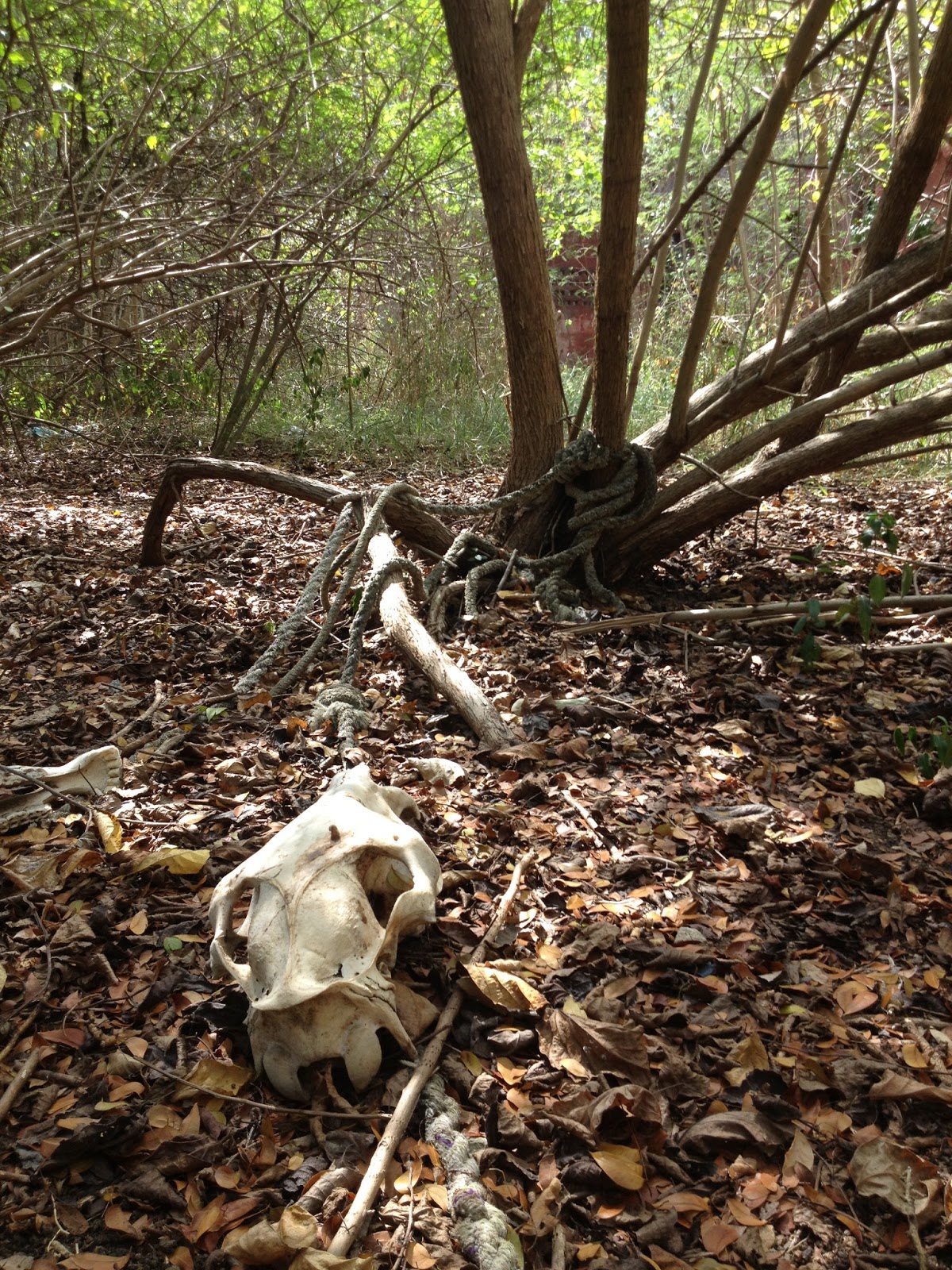
While I was there we happened upon some bones in the courtyard. It was the same courtyard that two hundred years ago enslaved people would have been forced to work as their punishment, doing back-breaking tasks like breaking rocks.  I found in the courtyard bones of an abandoned horse that was left tied to a tree. Someone just left the poor animal there. Perhaps they forgot it. I find it to be an interesting metaphor.

Sunday, October 2, 2011

Video Footage: Time, Place and Memory

This weekend the Virgin Islands Humanities Council held their signature event, the "We the People" conference with this year's theme, "Time, Place and Memory". As I am one of their grant recipients they invited me and two other documentary projects to present our works. Since I am in the very beginning stages of my documentary I presented two short trailers. One is already posted on this site. The other I'll post here which is montage of various footage. For me it was nuts, absolutely crazy, to put something together that quickly. I lost one full night of sleep. But it was a good exercise. It helped me wrestle with how I would weave the story together, how I might visually represent the previous owners, what do I want from my interview subjects.

Attending the conference reinforced for me how important it is to collect these memories. As I looked over the footage of my first interviewee, Gerville Larsen, a historical preservation architect, it made me realize that I really want to be able to access those memories, the personal ones, the smell of the place, if the street was shady, what did it feel like to breathe the air, was it heavy with heat, or light with a fragrance of bread baking or sweet from a ground littered with rotting mangoes. And although with this interview, even though I thought it went well, Gerville was articulate and passionate, it made me realize that I want to be able to access more, especially when I begin to interview people who actually lived in Free Gut.

I look forward to more interviews and research and continue to learn and improve production. Comments are most welcome on what you think about the footage so far.

Saturday, July 9, 2011

Funding Trailer #1

This is a funding trailer I developed as a part of the application process for a grant from the Virgin Islands Humanities Council. Wish me luck!

I started with using Vimeo, which has a higher quality, until I realized that you could not watch the video using a cell phone.

The House That Freedom Built from La Vaughn Belle on Vimeo.


So I decided to also post on YouTube. So if watching from your smartphone you should be able to see this one.


Since this is also a production blog I will comment a bit on that. Most of the footage was shot by Jason Roberts, except the shot where I am sitting and describing the motivation for the film. Due to deadlines and scheduling conflicts I shot that myself in my living room.

I so need funding to get better equipment! But a wise friend told me this:"The best camera to get is the one you have". So I push on filming what needs to be filmed, but writing away like a mad woman to get funding to take the production up a notch.

Saturday, May 14, 2011

Why we don't remember


The house is located in an area of Christiansted that is forgotten, abandoned both physically and psychologically. It is a part of an amnesia in our social memory. Why? Most people when they ask where the house is and I begin to tell them, don't have any visual references in mind. Their images and memory stop at about Company Street. Through my research I've learned that the town was designed to have a social, commercial and even racial divide. All the main buildings that had the most importance to colonial commerce were located near the waterfront. The laborers were placed in areas in the back streets. The first freed blacks were placed there by law in the 1700's as a form of urban segregation and control. How is it that we don't remember them? Them, the people who worked extra hard on Sundays, their only day off, week after week, to purchase freedom for themselves or for a loved one? How is it that we don't remember them?